Include your spice cabinet in spring cleaning

If the contents of your spice cabinet have been around for a year or more, it’s time to spring clean your seasonings.
Herbs and spices are the miracle workers of delicious cuisine. But over time they lose their intensity, meaning that 2-year-old bottle of dried oregano hiding in the back of the cabinet won’t add much pizazz to your pasta.
Here are some tips for keeping your dried herbs and spices top notch:
“Purchase in small quantities to ensure you finish them before the flavor dissipates (six months to a year).
“When possible, opt for whole spices, which you can grind in seconds at home with any blade coffee grinder. Whole spices retain their flavor and complexity much longer than pre-ground spices do, which can quickly lose aroma and flavor, says Jill Norman, author of “Herbs & Spices: The Cook’s Reference.”
“Buy seasonings from retailers with high turnover, ensuring the freshest possible product. They should be vivid in color and bold in scent when rubbed, nearly what they would’ve been like fresh.
“Buy from online specialty shops, such as Penzeys Spices, World Spice Merchants or Kalustyan’s, which sell small amounts of most seasonings are affordable prices.
“Store herbs and spices in airtight glass, ceramic or stainless steel containers in a cool, dark spot, such as a cabinet. Open racks expose seasonings to heat, light, oxygen and moisture, which ruin them.
“As seasonings near the end of their lifespans, find uses for them that won’t reflect their age. Blend savory seasonings with salt for use in soups or on popcorn. Cinnamon and other sweet spices can be blended with sugar (granulated or powdered) and used to dust buttered toast, cakes, cookies or hot chocolate.
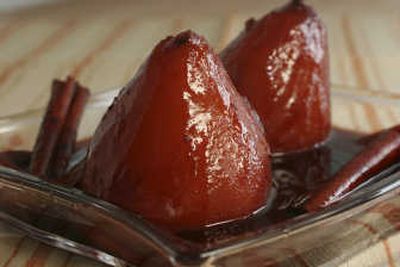
Cardamom, vanilla and cinnamon combine with red wine for an intensely aromatic syrup in which to poach these pears. The recipe calls for Moroccan wine, but any robust red wine will do.
Pears Poached in Red Wine
Recipe adapted from Trish Deseine’s “Nobody Does it Better…,” Kyle Books, 2007
1 (750-millileter) bottle robust red wine
1 1/2 cups sugar
2 cinnamon sticks
1 vanilla bean, slit down the center
2 cardamom pods
Juice of 2 oranges, plus the zest from one of them
1 orange, skin on, cut into 4 or 5 slices
4 ripe pears
In a large, heavy saucepan over high heat, combine all ingredients except the pears. Boil for 10 minutes.
Meanwhile, peel the pears, leaving the stem intact. Carefully cut just enough off the bottom of each pear to create a flat bottom so the pears will stand up straight.
Stand the pears in the saucepan, cover and reduce to a simmer. Poach the pears, basting occasionally, for about 40 minutes, or until the pears are tender but still hold their shape.
During cooking, the poaching liquid will become syrupy. If the pears are cooked before the syrup has reduced enough, remove the pears and let the syrup cook and reduce.
Serve the pears with an orange slice and drizzled with syrup.
Yield: 4 servings
Approximate nutrition per serving: 216 calories, less than 1 gram fat (3 percent fat calories), less than 1 gram protein, 55 grams carbohydrate, no cholesterol, 4 grams dietary fiber, 1.8 milligrams sodium.
Traditional versions of this heavily seasoned chicken from Myanmar call for using a mortar and pestle to create the thick, aromatic marinade. A food processor can be used to speed up things.
Khaukswe Chicken
Recipe adapted from Allegra McEvedy’s “Coloring the Seasons,” Kyle Books, 2007
1 1/2 teaspoons cumin seeds
2 tablespoons pumpkin seeds
2 tablespoons sunflower seeds
2 tablespoons sesame seeds
Salt, to taste
6 garlic cloves, peeled
2 red chilies, chopped
2 tablespoons vegetable or canola oil
1 teaspoon turmeric
1 teaspoon paprika
2 tablespoons tamarind paste
1 teaspoon dried shrimp paste, dissolved in 1 tablespoons hot water
Juice of 2 limes
Freshly ground black pepper, to taste
1/4 cup coconut milk
6 tablespoons plain yogurt
3 pounds boneless, skinless chicken breasts and thighs, cut into about 12 large pieces
For the garnish:
1/2 cup chopped fresh cilantro
2 red chilies, seeded and finely chopped
Zest of 4 limes
2 garlic cloves, peeled and finely chopped
Salt, to taste
In a large, dry skillet over medium-low heat, combine the cumin seeds, pumpkin seeds, sunflower seeds and sesame seeds. Sprinkle with a bit of salt; heat, stirring often, until the seeds are lightly toasted. Let cool.
In a food processor, combine the garlic, chilies, oil and a pinch of salt. Pulse until the garlic is well chopped. Add the turmeric, paprika and the toasted seeds. Pulse until a chunky, golden paste forms.
Add the tamarind, shrimp paste, lime juice, black pepper, about 1 teaspoon salt, coconut milk and yogurt. Pulse until well mixed. Transfer the marinade to a large bowl.
Add the chicken and rub the paste all over the chicken. Cover and refrigerate at least 3 hours.
When ready to cook, preheat the oven to 350 degrees.
Line a rimmed baking sheet with foil. Place a metal cooling rack over the baking sheet. Arrange the chicken on the rack. Roast for 35 minutes, or until the juices run clear.
Meanwhile, prepare the garnish. In a small bowl, combine the cilantro, chilies, lime zest, garlic and salt.
When the chicken is done, pile it on a serving platter and sprinkle with the cilantro mixture.
Yield: 6 servings
Approximate nutrition per serving: 391 calories, 16 grams fat (3 grams saturated, 38 percent fat calories), 51 grams protein, 7.5 grams carbohydrate, 133 milligrams cholesterol, 1.6 grams dietary fiber, 327 milligrams sodium.