
Chiefs coach shows modesty of recent success
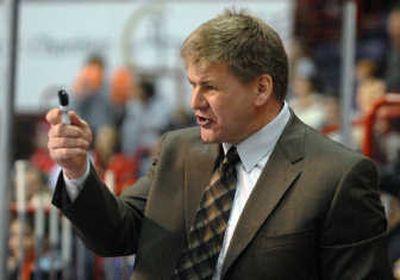

It’s Tuesday morning. Bill Peters is dressed casually in jeans and a polo shirt and busy with last-minute details at the Arena. His desk phone rings, followed by two calls on his cell phone – all within a minute. To say things are hectic for the third-year Spokane Chiefs coach is an understatement, but for a coach to still be this busy in the middle of May is a good thing in the hockey world.
“The shortest a season can be is seven months – that’s too short,” Peters said. “Going for nine (months) is much better. We aren’t ready to hit the links just yet.”
But even if his Chiefs weren’t frantically preparing for today’s departure to Kitchener, Ontario, to compete for a national major junior hockey title in the Memorial Cup, Peters still wouldn’t want to talk about himself. He’s just not the type.
“If I’d have known this was about me, I wouldn’t have scheduled (the interview),” joked the 43-year-old Peters. “You tricked me. I thought (it) would just be the normal stuff.”
“Normal” seems like an inappropriate term when talking about a team that tied a franchise record with 50 wins this season and brought home the second Western Hockey League title in Chiefs history (the first was in 1991).
Maybe by Peters’ tough standards, the grind of a season that isn’t even over is what he would expect to be the norm, but history proves the accomplishments of this year’s Chiefs are anything but ordinary.
Just four years ago it seemed unlikely.
The Chiefs had just finished in the Western Hockey League’s cellar and missed the playoffs for the first time in franchise history. That led to the firing of Al Conroy and the ensuing re-hiring of Peters, who was an assistant coach in Spokane from 1999-2002.
In Peters’ first season as Spokane’s bench boss, the Chiefs missed the playoffs again and owner Bobby Brett promised season ticket holders their money back if a third straight postseason was missed. Brett’s wallet was kept safe, though, when the Chiefs finished fourth in the U.S. Division last season and nabbed a playoff berth, making a quick exit in a 4-2 series loss to Everett.
For Peters, who grew up in a pair of small farming communities in Alberta, there was still work to be done.
“He’s just a straight, old-fashioned Alberta redneck,” Detroit Red Wings coach Mike Babcock, who coached Peters at Red Deer College, told The Spokesman-Review in 2005. “He’s straightforward, honest, and there is no gray area. He has unbelievable passion and energy for hockey – and learning in general.”
Peters worked for his father in the oil fields in Alberta after his playing career ended, only to realize he didn’t want to do that forever.
He married his high school sweetheart Denise in 1990 (they’ve since added two children – a 9-year-old girl and 4-year-old boy – to the equation), and moved with her to San Antonio for what was supposed to be a 13-week travel nursing assignment. They stayed for eight years, in which time Peters earned his degree in kinesiology from UT-San Antonio and helped open the first hockey rink in a city that at the time had a population of 1.3 million people.
“Longest 13 weeks of my life,” Peters said. “But business was good. Two sheets of ice for 1.3 million people, you do the math.”
He ran hockey camps, worked with the Dallas Stars a little and traveled to Spokane each August to help with training camp. His passion for the game kept calling him back to the ice, and he was brought on by Babcock and the Chiefs in 1999.
After three years as an assistant in Spokane – once under Babcock and twice under Perry Ganchar – the head coaching job opened up in 2002. Peters was told he wasn’t ready, so he went where he could get head coaching experience – the financially starved program at the University of Lethbridge, where in his last season the Pronghorns went 3-23-2.
But he got the experience he needed, and was ready when the job opened in Spokane again in 2005.
Peters was presented with a three-year contract extension in December that will keep him busy through the 2010-11 season.
“Yeah (that was exciting), otherwise you’re unemployed, right?” Peters said. “Who’s kidding who? This is a competitive business, and you want to do a good job.”
To say that Peters has done a good job – that might be the true understatement.