The return of the Dutch oven
Popularity fueled by lower cost versions of cast-iron pots
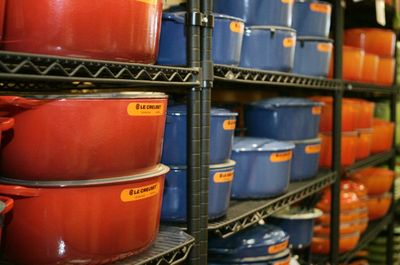
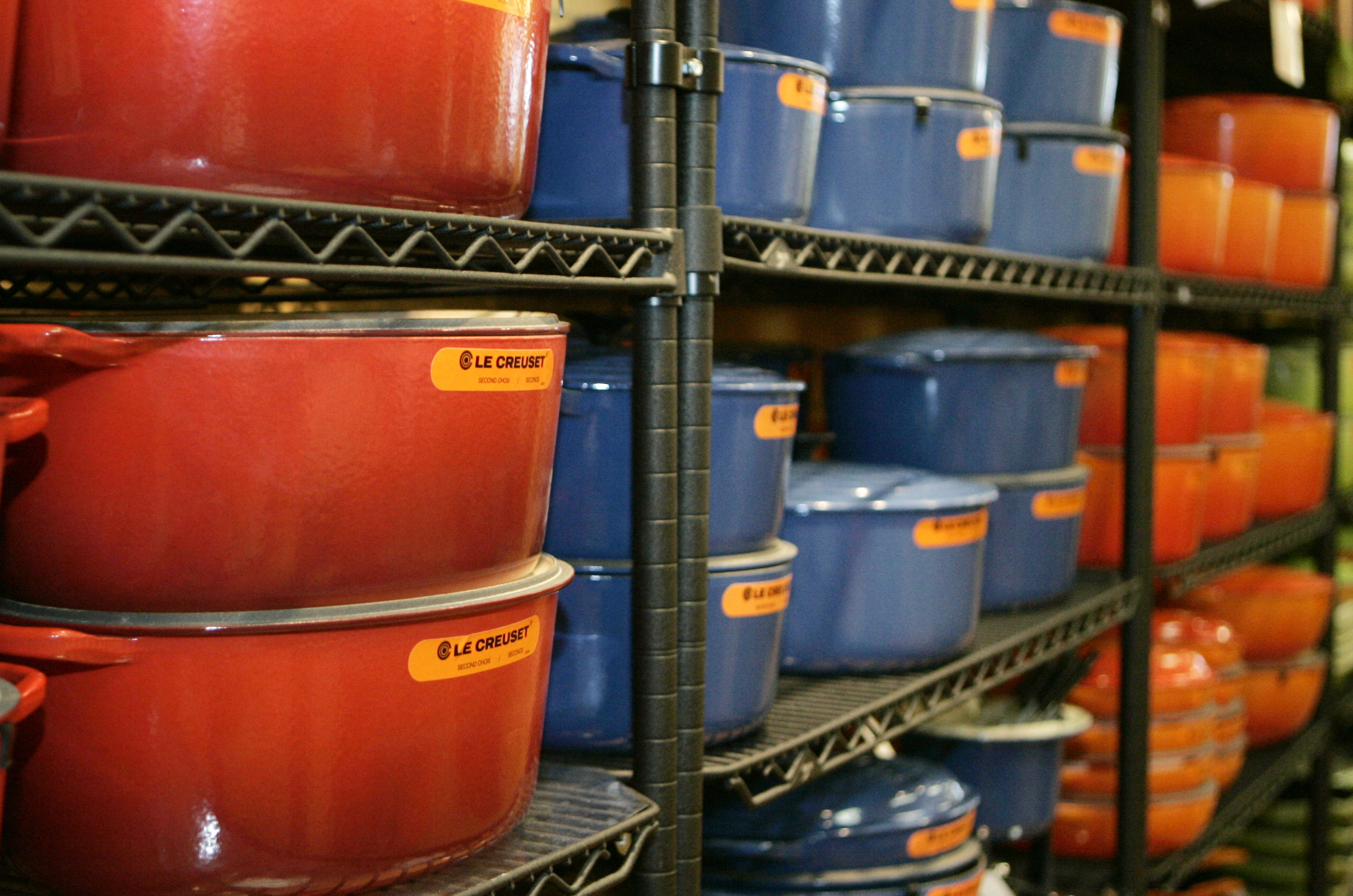
Going Dutch is getting seriously stylish.
Dutch ovens, that is. After some 300 years as a staid kitchen workhorse, these heavy cast-iron pots have become must-have accessories for the cook who wants it all. And until recently, bragging rights could set you back hundreds of dollars.
But the success of high-end brands such as Le Creuset, whose iconic brightly colored pots are as much display pieces as cookware, has spawned a fast-growing kitchenware niche of cheaper knockoffs.
Suddenly splashy enameled cast-iron Dutch ovens seem to be everywhere. Martha Stewart has her own line at Macy’s, while versions bearing the names of celebrity chefs Mario Batali, Paula Deen and Rachael Ray are at retailers nationwide.
Even Lodge Manufacturing Co., the South Pittsburg, Tenn.-based maker of workaday cast-iron pans, during the past four years has launched two lines (mid- and low-cost) of colored enamel versions of its Dutch oven.
The company says the low-cost line will represent 20 percent of its business by the end of this year.
“To have made these strides so quickly, we’re ecstatic,” says Mark Kelly, Lodge’s marketing promotions manager. “We’re an old, family-owned company, but we’re doing new things.”
The appeal has as much to do with aesthetics as cooking, with many people selecting ovens based on kitchen decor. “I don’t know how much people cook with it, sometimes, but they decorate their kitchen,” says Kim Collins, senior brand manager for Le Creuset.
For those who do cook with them, durability and versatility are key selling points.
“This is cookware you can keep for a long time,” says Kate Dering, a cookware buyer for Seattle-based kitchen retailer Sur la Table. “You can braise and bake all in the same pot and make an economical meal, like a roast or soup. That’s why people are buying them.”
Retailers across the spectrum have responded to the demand. The pots are standard fare for Williams-Sonoma, where a 15 1/2-quart red oval Le Creuset Dutch oven fetches $415, as well as for Wal-Mart, where a green 3 1/2-quart Tramontina goes for under $30.
Le Creuset and Batali brand Dutch ovens are among Sur la Table’s best selling items, says Dering. And to keep up with demand, the company stocks 40 percent more of them than just a few years ago, she says.
Cast-iron Dutch ovens, which can be round or oval, have been around for centuries, dating to at least 17th century Europe. Because they originally were intended for hearth-style cooking, most early versions had legs for standing them over a bed of coals.
Then and now, they are prized for their ability to retain heat and moisture and move easily from the stovetop to the oven, making them ideal for stews, baked beans, roasts, braising, even baked goods.
“They’re the original slow cookers,” says Vernon Winterton, author of “101 Things to do with a Dutch Oven.”
Erin Doland was a reluctant convert to Dutch ovens. At least initially. She was happy with her electric slow cooker, wasn’t sure she had the kitchen real estate to dedicate to another pot, and figured she’d someday inherit her mother’s black Dutch oven.
Then the Reston, Va., freelance writer saw a black 9 1/2-quart Le Creuset on sale for half price at an outlet. Memories of her mother’s kitchen and macaroni and cheese with just the right crunch on top came flooding back.
She says the memory alone was almost worth the $169.26 she paid for the pot.
“As a kid, it was one of the few foods I would eat. I was quite a picky eater,” Doland says. “And it was the first thing I imagined myself making in my Dutch oven.”
Lisa McManus, senior editor at Cook’s Illustrated magazine, says the hype about Dutch ovens is merited. She spent a month testing numerous models for a review. She says they excel at keeping food moist, and even double as a deep-fryer.
Le Creuset and All-Clad versions were test-kitchen favorites, McManus says, but testers found that a cheaper version, such as the 6 1/2-quart Tramontina model sold for about $40 at Wal-Mart, was a good, inexpensive alternative.
“The ones that we tested, we use them every day and we make everything in them,” she says. “It’s one of those pots you buy once and hand down to your grandchildren.”
Making baked beans from scratch isn’t fast, but it is easy. Though the dry beans do need to be soaked overnight, then baked for a couple hours, actual hands-on cooking time is just about 15 minutes. And the taste of the finished product is worth it.
This recipe from Marie Simmons’ “Things Cooks Love” is a great excuse to haul out your heavy Dutch oven. Dress these beans with sautéed cherry tomatoes, chopped fresh Italian parsley and pitted kalamata olives.
Oven-Baked Cannellini Beans
From Marie Simmons’ “Things Cooks Love,” Andrews McMeel Publishing, 2008
1 pound (about 2 1/2 cups) dried cannellini beans (or other dried white beans)
4 cloves garlic, peeled and lightly crushed
2 tablespoons extra-virgin olive oil
1 small yellow onion, halved
1 bay leaf
2 to 3 cups water or unsalted chicken broth, or as needed
Coarse salt and ground black pepper
Place the beans in a large bowl, then add enough cold water to cover them by at least 2 inches. Cover the bowl with plastic wrap and refrigerate for at least 4 hours or up to overnight.
Alternatively, place the beans in a large saucepan, add enough cold water to cover by 2 inches, then bring to a boil, cover and boil for 3 minutes. Remove from the heat and let the beans stand in the water, covered, for 1 hour.
Use a colander to drain the beans.
Heat the oven to 325 degrees.
In a medium to large Dutch oven (4 to 8 quarts), combine the beans, garlic, olive oil, onion and bay leaf. Add enough water or broth to cover the beans.
Cover the pot and bake for 1 1/2 to 2 hours, or until the beans are tender. Remove from the oven and let stand, covered, for 30 minutes. As the beans cool, they will absorb most of the excess cooking liquid.
Scoop out and discard the onion halves and bay leaf. Use a mesh strainer to drain and discard any liquid not absorbed by the beans. Season the beans with salt and pepper.
Yield: 8 servings
Approximate nutrition per serving: 218 calories, 4 grams fat (less than 1 gram saturated, 17 percent fat calories), 12 grams protein, 34 grams carbohydrate, no cholesterol, 14 grams dietary fiber, 2 milligrams sodium.
Pears, wine and sugar have a happy marriage inside a Dutch oven, creating a tender, sweet dessert. Topped with applesauce and whipped cream, these pears make an excellent autumn dessert.
Roasted Red Pears
From Julie Kramis Hearne and Sharon Kramis’ “The Dutch Oven Cookbook,” Sasquatch Books, 2006
1 tablespoon salted butter
1 1/4 cups sugar, plus 2 tablespoons, divided
5 Jonagold (or other sweet, crisp variety) apples, peeled, cored and chopped
3 tablespoons chopped walnuts
1 cup red wine
1 cinnamon stick
1 strip of lemon zest
6 Bosc pears, peeled but not cored
1 pint heavy cream
In a medium saucepan over medium-low heat, combine the butter and 1/4 cup of the sugar. Heat until the butter has melted. Add the apples, cover and cook until soft, about 10 minutes. Remove from the heat and add the walnuts. Set aside.
In a 5 1/2-quart Dutch oven, bring the red wine and 1 cup of the remaining sugar to a boil.
Add the cinnamon stick and lemon zest. Reduce heat to simmer. Slice off the bottom of each pear, cutting only enough to create a flat surface so the pears can stand upright.
Stand the pears in the Dutch oven. Cover and simmer for 30 to 40 minutes, or until tender. Transfer the pears to a platter.
Increase the heat under the Dutch oven to medium and simmer the liquid until reduced to a thick glaze, about 10 minutes.
In a large bowl, whip the cream with the remaining 2 tablespoons of sugar until stiff peaks form. Set aside.
Divide the apple mixture between 6 serving plates. Stand a pear on top of the apples on each plate, then spoon some of the glaze over each. Serve with a dollop of whipped cream.
Yield: 6 servings
Approximate nutrition per serving, without whipped cream: 352 calories, 5 grams fat (1 gram saturated, 12 percent fat calories), 1 gram protein, 79 grams carbohydrate, 5 milligrams cholesterol, 5 grams dietary fiber, 1 milligram sodium.
Dutch ovens are a versatile tool in the kitchen. In addition to the usual roasts, soups and stews, they also can turn out fantastic baked goods, as in these rolls studded with cranberries and scented with orange zest.
Orange Cranberry Rolls
Adapted from Vernon Winterton’s “101 Things to do with a Dutch Oven,” Gibbs Smith, 2006
1 tablespoon active dry yeast
2 cups warm water, divided
7 tablespoons sugar, divided
6 cups all-purpose flour, plus more for dusting work surface
2 teaspoons salt
1/4 cup instant nonfat dry milk
6 tablespoons unsalted butter, softened
1 cup dried or frozen cranberries
2 teaspoons orange extract
Zest of 2 oranges
In a small bowl, whisk together the yeast, 1 cup of the water and 4 tablespoons of the sugar. Set aside.
In a large bowl, whisk together the flour, salt, dry milk and remaining 3 tablespoons of sugar. Add the butter and cranberries, then use a rubber spatula to fold the mixture together. As you mix, pour in the yeast mixture, orange extract and orange zest.
As you mix the dough, be sure to scrape up any dry flour from the bottom of the bowl. Add the remaining 1 cup of water and mix well. Use wet hands to knead the dough in the bowl until elastic but not sticky, about 10 minutes.
Cover the bowl with plastic wrap and let the dough rise for 30 minutes, or until it doubles in size.
Transfer the dough to a lightly floured work surface and knead 10 to 15 times. Punch down the dough and divide into 16 balls.
Place a 12-inch-round Dutch oven over low heat for about 30 seconds. Let the pot get just barely warm to the touch. Do not let the bottom get hot. Remove from the heat. Coat the pot with cooking spray.
Arrange the balls of dough in the Dutch oven; they will touch. Cover loosely with plastic wrap and let rise at room temperature until the rolls double in size and do not readily spring back when poked with finger, at least 1 hour.
Adjust an oven rack to the lowest position and heat the oven to 350 degrees.
Cover the Dutch oven with its lid, then bake the rolls for 30 minutes. Remove the lid and continue to bake until the rolls are browned, about another 15 minutes. Carefully remove the rolls from pot, cool and serve.
Yield: 16 servings
Approximate nutrition per serving: 235 calories, 5 grams fat (2.7 grams saturated, 19 percent fat calories), 5 grams protein, 42 grams carbohydrate, 12 milligrams cholesterol, 2 grams dietary fiber, 293 milligrams sodium.