
Top tier: From Whitworth to national QB expert, Mike Sando has excelled in career as sports reporter
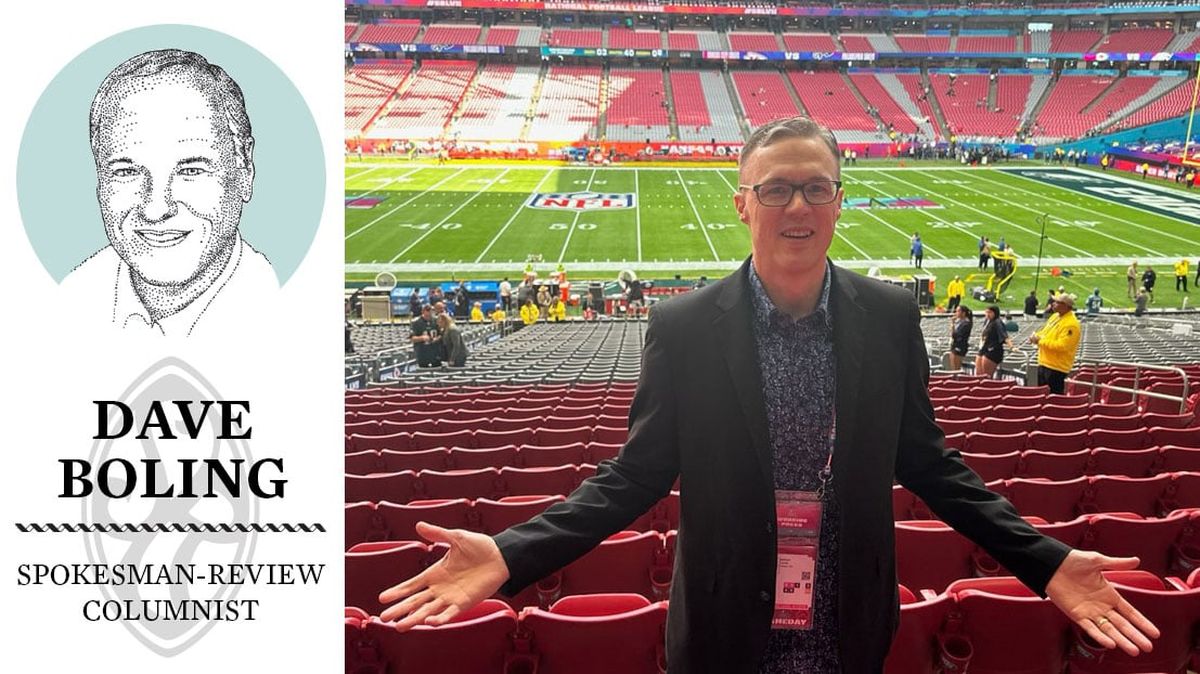
Mike Sando recognized a football truism: Every fan watches the quarterback.
But few understand what separates the elite from the ordinary, and there weren’t sources to credibly settle the resulting debates.
Sando started addressing this as a curious reporter asking questions, in confidence, of the people best qualified to provide insightful answers about the most important position in all of sports.
Two keys to making this work: He gained access to so many NFL insiders that his annual Quarterback Tiers rankings carried unquestioned authority. And that breadth of sources largely eliminated any of the customary claims of bias.
Over 12 seasons, Sando’s QB Tiers project has become one of the hottest national media productions, first at ESPN and, since 2019, at the Athletic.
The Tiers publication this month led to 65 national and regional television, radio and podcast appearances for Sando, with promotional billboards displayed in New York City, Dallas and Chicago.
Sando, 55, enlists a collection of 50 anonymous insiders – executives and coaches – who cast votes and offer their analyses.
Not bad for a Whitworth grad (1992), who started out taking calls of prep results on The Spokesman-Review sports desk.
Dan Kaufman, Sando’s former editor at ESPN and the Athletic, assessed his reputation as this: “In my mind, Mike Sando is the best football reporter and football writer in the country.”
It’s possible, then, if somebody endeavored to rank national NFL reporters, Mike Sando would be placed in the top tier – maybe even by himself.
• • •
The NFL is among the most-competitive environments imaginable, populated by a community of suspicious and tight-lipped operators. Among those generally unworthy of their trust, the media is surely high on the list.
How did Sando even consider patching together such a group of insiders, which this year included six general managers, eight head coaches, 15 coordinators and six former GMs?
Some years ago, when Sando was with ESPN, he was brainstorming ideas with former NFL executive and Hall of Famer Bill Polian. Sando wanted to know, from someone who spent his life evaluating talent, how to dissect quarterback play.
He could have researched and relied on knowledge gained in his career of covering the NFL (now at 28 years), “but I thought, ‘who gives a rip about what Mike Sando thinks?’ ” He knew he didn’t have definitive answers. So, he started asking people who did.
“I think when you’re genuinely interested in learning, and you’re coming at it from that point, the world opens up to you in terms of people (being) interested in talking to you,” he said.

The first year, he started with 26 insiders. The core of sources grew to 55. He’s settled on 50 sources, now, with the roster shifting by as much as 50 % in some years.
The sheer number of participants counters concerns over voter bias. And on his desk, near his computer, Sando reminds himself what he’s seeking: “Insights, not agendas.”
“You want to be fair,” he said. “Sometimes I’ll use quotes that are critical of a player, but I’ll try to make sure it’s not personal. … I want the reader to come away going, ‘OK, that’s interesting,’ not ‘oh, man, that was too one-sided.’ ”
Kaufman said he didn’t want to give specifics of Sando’s approach, but suggested the strength of his interviews lies in his preparation.
“When Mike goes in to talk to people, he has educated himself on who they are and what their issues are,” Kaufman said. “He’s not coming just to ask questions, but, ‘hey, did you know this about your team?’ (So), it’s a two-way conversation.”
Some in the business who know Sando suggest that his personality helps open doors.
Rob Rang, a pro talent evaluator and NFL draft analyst: “He has such an easy-going way about him, (he makes) the NFL decision-makers feel at ease with him. He’s an awfully nice guy, and there are a lot of them out there, but few of them are as revered in his own industry as Mike is.”
Sando makes it clear that his search for answers is not an adversarial exercise.
“I don’t want it to be portrayed as, hey, you’re not a tough journalist,” Sando said. “But I think in life there’s a way to respect people. It’s a subtle understanding and acknowledgment that the coach knows more about football than you do.”
• • •
Some people naturally discover their career path, others are physically dragged there by the collar.
Sando had worked on the school paper staff as a freshman at Mira Loma High School (Sacramento). But he didn’t sign up for it his second year. Sando was minding his own business in a history class early that semester when journalism teacher Len Frizzi walked in, grabbed him by the collar, and hauled him down to the office to re-enroll him in the newspaper class.
“I really didn’t feel like I had an option on this thing,” Sando said.
He became sports editor for the school paper as a senior, and continued that path at Whitworth.
Early in his freshman year (1988), he was assigned to cover what turned into a lopsided football loss to Central Washington. He covered the 61-7 defeat as fairly as possible, but the paper’s editor slapped a provocative word in the headline (“Annihilation”) on his game story, and when Sando returned to his dorm room, offended players had taped threatening notes to his door.
“I was totally rattled; I felt like, oh, no, my career is over. How am I going to go out and cover these guys?” he said. “It was comical, you know, but in retrospect, you also learn that what you write affects people.”
Weekend desk work led to an internship with The Spokesman-Review, and then a job there as a copy editor. Preps and small college coverage – and mobility – helped Sando soon take a significant leap, as beat reporter for Washington State football and basketball.
“It was a plum job, and I never applied; it never occurred to me to apply,” he said. “I think what happened was all the other guys on the staff were older and didn’t want to move to Pullman.”
The timing was spectacular. “I kind of lucked into the (1997) Cougars going to their first Rose Bowl in 67 years.”
• • •
When legendary NFL reporter John Clayton moved on to ESPN, the Tacoma News Tribune had an enormous hole to fill.
Although he had no experience covering the NFL, Sando’s promising work with the Cougars landed him the job … at age 28.
Clayton’s sensational source development and his attention to detail was key to his success. Even though he left the Tacoma paper, he still eagerly mentored his youthful replacement.
“I think of how welcoming John Clayton was,” Sando said. “John was great to me. … I would just follow John around at the (NFL) combine and Super Bowls, and meet tons of people that way.”
Clayton’s seal of approval opened doors, Sando said, and their shared interests and commitment led to a long friendship.
“John was such a strong personality and believed so strongly in how to do things, it couldn’t help but shape you,” Sando said, recalling times when he might be on the phone with Clayton for many hours a day.
This was another time when Sando touted great timing in his progression in the business. The Cougars going to the Rose Bowl, and then, shortly after taking over the Seahawks beat, they hired Mike Holmgren as head coach. “In six years, they were going to the Super Bowl.”
During that process, Sando embraced the varied ways the internet became a more expedient means of breaking news than the morning newspaper. His widely read weblog at the TNT attracted the attention of ESPN, which, in 2008, hired him away as the NFC West blogger.
Kaufman saw even greater potential, and moved Sando into an ESPN Insider position.
“We didn’t just want people who would break news, we wanted people who could tell different kinds of stories, who could get access, and who could take readers someplace nobody else was taking them,” Kaufman said.
For the last 15 years, Sando also has been a Pro Football Hall of Fame selector, representing the Seattle market. As such, he’s made presentations to the other selectors regarding the Hall worthiness of Cortez Kennedy, Walter Jones and Steve Hutchinson.
“I love trying to kind of adjust for the eras in appreciating the best of the best … finding ways to contextualize the performance of people over different times,” he said.
• • •
One fellow reporter said that at league meetings, executives are practically lining up to talk to Sando about his projects. Sando deflected that as just a matter of being in the right coffee shop.
Rang said that at an NFL training camp on the road, recently, he saw a GM connect with Sando for the length of an entire practice, chatting him up as if he were “an old high-school buddy.”
One quality Sando learned from Clayton was the willingness to share his experience.
“Mike was such a massive influence in my career,” said Rang, who was still a student teacher in Tacoma when he approached Sando for advice about trying to become a talent evaluator.
Sando told him he needed to get to the combine to build connections. Good advice, but Sando went well beyond that.
Rang: “He said, I’m going (to the combine), and if you want, I’ll let you stay in my hotel room to cut the travel cost for you.”
Sando downplayed that generosity, too. “He was just sleeping on the floor.”
Kaufman said Sando was surprised when the Athletic recruited him away from ESPN.
“It’s taken him a long time to realize who he is and how important he is,” Kaufman said. “His mind just doesn’t work that way. We all have egos, but he’s not driven by his.”
A little personal testimony is required here. I’ve worked with Sando since he first came to The Spokesman-Review more than 30 years ago. We’ve played untold rounds of golf and traveled many thousands of miles, particularly covering the Seahawks together.
For years, we shared press-box space, sideline observations, story ideas, family developments. Thousands of hours of laughs and pranks and busting chops. Watching each other’s kids grow.
Some might note that together we wove a trail of gluttony through the NFL, pregame buffets, halftime snacks, post-game pizzas, etc.
But so much more. The stuff of life.
When a bike crash left me with a demolished collarbone, and I couldn’t drive or prep food, Mike drove me to and from surgeries, and his wife, Kim, made a dozen or more Tupperware meals that I could just pop in the microwave.
Another time, coming back from a Super Bowl somewhere across the country, I was dreading a long flight because an old orthopedic injury was flaring up. I got to the airport and discovered that Sando had used his own frequent-flier miles to book me a first-class upgrade.
He didn’t make a big deal of it, as if such a thoughtful and uncommonly generous act was natural to him.
As Kaufman said: “Mike is such a genuinely good and nice person that it’s impossible to know him and not to root for him.”
Agreed. But there’s more to it than being genuine and genial.
It’s a mix of intellectual curiosity, and the understanding that coaches actually know more about the games than reporters, and it’s recognizing the massive chasm in the news between insights and agendas.
As a reporter – and as a friend – those things put Mike Sando in a tier of his own.