Kidney friendly
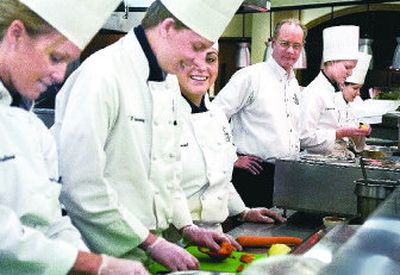
Standing on a chair in his grandmother’s kitchen, Duane Sunwold started cooking at age 4 and never stopped. By the fourth grade, flour streaks matched the grass stains on his pants as he mastered the mysteries of pie crust and he never looked back.
Sunwold currently serves as the department chair for the Inland Northwest Culinary Academy at Spokane Community College, where he first picked up his professional chef credentials in the 1970s before heading north to the Southern Alberta Institute of Technology for additional training. Along the way he served as sous chef at the Hayden Lake (Idaho) Country Club and took only two years to advance from waiter to assistant general manager at a resort in Hawaii. In 1982, he returned to SCC to teach and has led the culinary arts department for 12 of the last 16 years.
The four-year gap in his time of service is significant. In the fall of 1999, he told the department he could no longer serve as chair. Even with the rest of summer behind him, he felt exhausted. Looking back he realized this deep tiredness had been building for several years, and he stopped trying to ignore it. It was all he could do to survive his own teaching load.
Then 11 months later, on his 43rd birthday, Sunwold woke up with a massive migraine and the right half of his face suddenly swollen to Elephant Man proportions. Numerous doctor visits failed to find any cause for the ongoing exhaustion, or the new headaches and swelling. Out of exasperation in December, a Group Health physician’s assistant ordered a blood and urine work up and caught something. Sunwold’s kidneys were spilling the protein albumin like a punctured plane leaking fuel. Typically, a person might lose only 50 milligrams in their urine a day. Sunwold was losing 240 times that: 12 grams. Describing the situation with a rueful smile he says: “I was literally peeing egg whites,” (which are composed of the protein albumin).
A week later doctors admitted him to Sacred Heart with dangerously high blood pressure and a Teflon migraine that nothing but a morphine drip could touch. The diagnosis? Chronic kidney disease. The prospects? Grim.
Kidney disease mutates the structure in the kidneys. They begin to filter out protein that the body needs, even as they fail to remove toxins that eventually can destroy the kidneys altogether. Failing kidneys such as Sunwold’s function like an insane bouncer at a bar who refuses to let regular patrons in even as he starts packing the place with the deadbeats and hit men. It was only a matter of time.
In Sunwold’s case, not much time. Chronic kidney disease is measured in stages. Problems begin at stage one; stage five is organ shutdown and dialysis or transplant. In just months and despite massive doses of steroids and other meds, Sunwold hit 4.7: “I could feel dialysis,” he says.
Eighteen months after his initial diagnosis, desperate to talk to any doctor who might offer some hope, he sat down in the office of Dr. Katherine Tuttle from the Providence Medical Research Center at Sacred Heart. Since Sunwold was not her patient at the time, she remained circumspect. Yet, in addition to suggesting a couple of medication adjustments, Tuttle also mentioned that animal protein was particularly hard on struggling kidneys.
For someone whose livelihood is the kitchen, this passing comment stuck. None of the other doctors Sunwold had seen to this point had mentioned diet, but after Tuttle did, he passed it along to Erin Clason, the registered dietitian on the SCC faculty.
Clason knew much more realistically than he did how rapidly Sunwold was declining. And after a few days to think over Tuttle’s comment, she dropped by Sunwold’s office on a Friday to propose a 90-day experiment. She wanted him on a vegan diet that cut out the hard-to-process animal proteins as completely as possible.
For a man on massive steroids and craving cheeseburgers this sounded almost impossible, but Clason wisely proposed he not start until after the weekend. “Eat whatever you want for the next two days,” she told him.
With two days to eat anything and everything he wanted, Sunwold finally agreed and went home and ordered four large pepperoni pizzas with extra cheese. With the help of his family, he plowed through all four like a man eating his last pizzas.
This wasn’t that far from the truth. As wonderful as they tasted, the meat and cheese on those pizzas dropped Sunwold more effectively than a fully-charged Tazer. He spent the rest of the weekend in bed unable to eat another thing and when he crawled into the office on Monday he was desperate enough to do anything for 90 days.
It only took 14. He realized they might be on to something huge when after only two weeks on a vegan diet, he felt better than he’d felt for a year and a half of heavy drug treatment. Remarkably, his lab work confirmed his experience. He didn’t just feel better, he was better.
The change bordered on miraculous, but an easy miracle it wasn’t. Forty years of eating habits for someone who adores food don’t change because four pizzas one weekend made you sick. Still on steroids that made him crave meat, Sunwold remembers a day he went shopping with his father. As lunch approached, he begged his dad to pull into the drive-through of any one of the fast-food restaurants along the length of Sprague. When his father refused, Sunwold rolled down his window and hung out his head to at least smell the meat cooking as they drove by.
Tuttle says this is why treatment of chronic kidney disease has typically not pushed diet change. “It is much easier to give pills.” Sunwold agrees. At first he worked only to cut out animal protein, but in time he realized he also needed to avoid salt and saturated fats. Sugar also surfaced as issue because he was borderline diabetic.
“Not everyday is a home run,” he says, but as a chef he has approached this as a cooking challenge rather than a career crisis. “Anyone can use a salt shaker,” he says. “Now I have to ask ‘How do I extract flavor without salt?’ ” Overcoming this challenge has made him a better cook and has put him on the cutting edge of creative cuisine for those with chronic kidney disease as well as people with diabetes, high blood pressure and heart disease.
He is asked to share his story with medical professionals nationwide and is working on a cookbook. Already his recipes have become a regular feature in the Journal of Renal Nutrition and the National Kidney Foundation included menus from Sunwold in their recently released 2007 Clinical Guidelines for Diabetes and Chronic Kidney Disease. Recipes in medical guidelines may not sound like a big deal, but they actually represent a huge shift to highlight lifestyle and diet in treatment. Sunwold is at the heart of this: pulling together his world as a culinary arts instructor and his experience as a patient in a way that could save far more lives than his own.
Sunwold’s shift to a primarily vegan diet came out of his fight with chronic kidney disease, but the principles he uses are equally valid for those struggling with diabetes, high blood pressure and heart disease. Since nearly 10 percent of the adult population in the United States now has diabetes (though much of it remains undiagnosed), and a full third of adults have high blood pressure, Sunwold’s work in the kitchen might well offer hope to many people desperate for hope and a higher quality of life.
The recipes below from Sunwold are featured in National Kidney Foundation’s latest Clinical Guidelines for Diabetes and Chronic Kidney Disease (www.kidney.org).
Baked Salmon with Roasted Asparagus on a Cracked Wheat Bun
From Duane Sunwold, reprinted with permission from the National Kidney Foundation
12 ounces fresh asparagus spears (woody stems removed), washed
1 tablespoon olive oil
16 ounces fresh salmon fillet
1 tablespoon lemon juice
1 tablespoon Butter Buds
4 cracked wheat or whole grain hamburger buns, toasted
Preheat oven to 400 degrees. Place asparagus spears on a cookie sheet and spray with olive oil. Roast in the oven for 10 minutes or until tender and slightly brown. Remove from the oven and allow to cool.
Spray baking dish with olive oil. Cut salmon into 4-ounce pieces. Place salmon fillets in baking dish and drizzle lemon juice over the top of each fillet. Bake 15 to 20 minutes until the salmon is flaky to the touch. Serve salmon on a toasted hamburger bun, sprinkle with Butter Buds and top with roasted asparagus and Habanero Hollandaise Sauce (recipe follows).
Yield: 4 servings
Approximate nutrition per serving: 475 calories, 20 grams fat (3 grams saturated, 38 percent fat calories), 32 grams protein, 43 grams carbohydrate, 62 milligrams cholesterol, 5 grams dietary fiber, 495 milligrams sodium.
Habanero Hollandaise Sauce
From Duane Sunwold, reprinted with permission from the National Kidney Foundation
6 ounces tofu, silken, extra firm, drained and crumbled
1/4 cup vegetable stock (recipe follows)
1/4 cup fresh lemon juice
1/2 teaspoon sugar
1/4 teaspoon turmeric
1/2 teaspoon diced habanero chilies (out of the jar), more if you like it spicier
Combine all ingredients in a food processor and process until smooth. Refrigerate overnight before serving.
Yield: 4 servings
Very Berry Tofu Smoothie
From Duane Sunwold, reprinted with permission from the National Kidney Foundation
1 pound fresh strawberries, cleaned and hulled
2 cups blueberries
9 ounces tofu, silken, extra firm
1/2 teaspoon ground ginger
2 pinches of red pepper flakes
1/4 teaspoon rum extract
1 tablespoon honey
1 teaspoon lemon juice
1/2 cup ice
Blend all ingredients together and serve.
Yield: 4 (1-cup) servings
Nutrition per serving: 125 calories, 1.8 grams fat (.2 grams saturated, 13 percent fat calories), 6 grams protein, 22 grams carbohydrate, no cholesterol, 6 grams dietary fiber, 42 milligrams sodium.
Sunwold also shared his recipes for Roasted Vegetable Stock and Chilled Gingered Apple Soup. They are reprinted with permission from the National Kidney Foundation.
Roasted Vegetable Stock
3 large onions
6 medium carrots
4 parsnips
2 leeks, white with 2-inches of the green top
8 white mushrooms
3 tablespoons vegetable oil
2 tablespoons dry Marsala wine
6 celery stalks
1 garlic head
4 plum tomatoes
3 fresh thyme sprigs
3 fresh parsley sprigs
8 whole peppercorns
1 bay leaf
Preheat oven to 400 degrees. Coarsely chop onions, carrots, parsnips, leeks and trim and quarter mushrooms. Place in two shallow roasting pans. Toss vegetables with oil. Place in oven and stir every 15 minutes until the vegetables are golden brown, about 1 1/2 hours. Transfer roasted vegetables to a stock pot or saucepan. Place roasting pans on stovetop. Add a tablespoon dry Marsala wine to each pan and pour 1 cup of cold water into each roasting pan. Heat over medium-high heat until water boils and brown drippings on the bottom of the pan can be scraped off. Pour roasting pan liquid into the stock pot with the roasted vegetables. Add the remaining ingredients and enough cold water to cover vegetables by 1/2 inch. Bring to a boil over high heat; reduce heat to a simmer and let cook for 45 minutes. Strain the stock and discard the vegetables.
Chill stock in a cold water bath before storing in the refrigerator or freeze for up to three months.
Yield: Varies
Nutrition per 1-cup serving: 21 calories, .5 grams fat (21 percent fat calories), .5 grams protein, 4 grams carbohydrate, no cholesterol, no dietary fiber, 27 milligrams sodium.
Chilled Gingered Apple Soup
3 Granny Smith apples, peeled, cored and diced
1 1/2 teaspoons fresh ginger, peeled and sliced into thin sticks
2 tablespoons water
12 ounces silken tofu, extra firm
2 tablespoons lemon juice
Pinch of nutmeg
1 tablespoon honey
2 tablespoons Splenda
1 cup rice milk
In a medium heavy-bottom saucepan simmer apples, ginger and water until apples are tender; about 12 to 15 minutes. Drain tofu and place in a food processor. Add apples and liquid from the saucepan into the food processor. Puree apples and tofu until smooth. Add lemon juice, nutmeg, honey and Splenda. Mix thoroughly and refrigerate overnight. When ready to serve add rice milk and stir before serving.
Yield: 6 (2/3 cup) servings
Nutrition per serving: 104 calories (2 grams fat, 17 percent fat calories), 4 grams protein, 19 grams carbohydrate, 36 milligrams sodium.