Clearing the air: Washington growers and scientists team up to protect wine from wildfire smoke
The glasses were laid out in a semicircle, each with a small pour of red wine and a plastic cover. Although it was still early in the morning, we were ready to taste (and spit). These were the product of Washington State University team’s research, led by professor Tom Collins, into the impacts of wildfire smoke on wine grapes and the wine made from them. I was eager, and a bit hesitant, as I began tasting, from left to right, the six glasses before me.
The tasting was part of a recent day of updates by members of the West Coast Smoke Exposure Task Force, a collaborative effort between a wide range of wine industry members and researchers from the state land grant colleges of Washington, Oregon and California and the USDA. Created in 2019, the group works to improve the understanding of how smoke may impact grapes and wine and share best practices on how to avoid and mitigate those impacts. In April, the Washington Advancements in Viticulture and Enology program of the Washington Wine Commission and WSU’s Viticulture and Enology Department co-sponsored an all-day update at WSU’s Tri-Cities campus.
Wildfire smoke has been an issue since the beginning of agriculture, but it became a significant subject of research only in the past 20 years or so. Major brushfires in Australia in 2003 impacted wine grapes to the degree that grapes and wines were rejected due to what’s sometimes termed “smoke taint.” While awareness began to grow in the U.S. due to wildfires in the early 2000s, the impacts of wildfires in 2020 were a game-changer, as vineyards across the region experienced significant smoke-related losses.
Wildfire smoke contains a wide range of compounds, which vary depending on the plant species burning. Phenols, a broad family of organic compounds essential for taste, aroma, color, mouthfeel and more in our food, occur naturally in grapes (and pretty much all plant-derived foods). Some volatile phenols associated with smoke can cause problems when absorbed in grapes, where they quickly bind with sugars. During fermentation and even during aging, the compounds are released and secondary compounds form that can create off-flavors and off-aromas associated with smoke.
Washington researchers were ahead of the curve when Collins began field tests in 2016 to expose grapes to controlled amounts of smoke. WSU’s field research continues under Collins’ leadership. He led us through the tasting, asking us to note our impressions, not revealing anything until we had tasted and compared all of the wines.
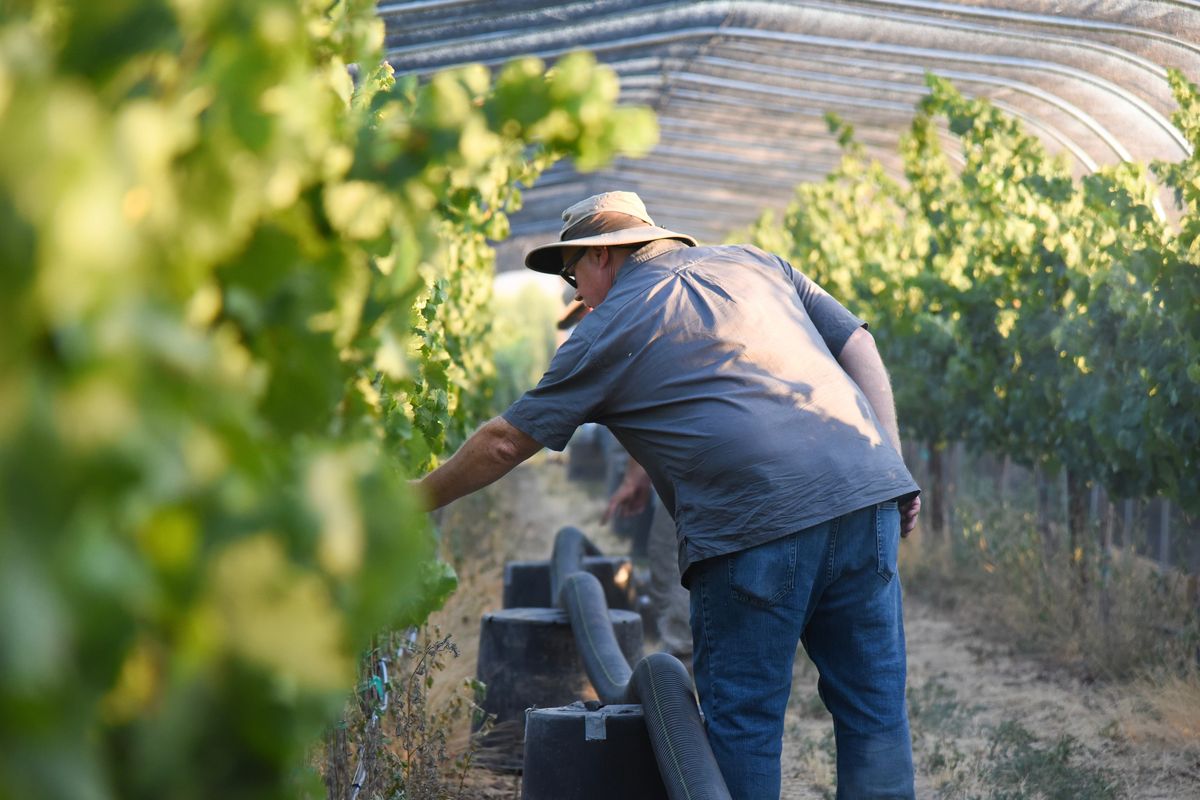
The wine was merlot, “research wine” from 2025, made in two batches: one from grapes with no smoke exposure, the other from grapes exposed to controlled smoke in a covered tunnel. The first wine was the control, 100% smoke-free. Each subsequent glass was a blend of the control and smoke-exposed wine, increasing to 100% in the sixth glass we tasted.
Because we tasted these blind and discussed them without additional knowledge, there were (to me) surprising differences in perception, even across what was a very wine-knowledgeable group that included growers, winemakers, researchers, students and other wine-related professionals. The perception of smoke was not linear with concentration for most of us, and people found several of the wines (in addition to the control) perfectly acceptable. One or two people – again, wine professionals – didn’t perceive any smoke aroma or taste.
Perception varies significantly between individuals, and 15% or more of people may not perceive any smokiness. The 100% smoke-exposed version stood out to most of us. Researchers used a pelletized rangeland plant blend to create the smoke. The sage and rabbitbrush came through as creosotelike in its aroma, though a bit less so in the mouth.
Therein lies just one of the many complexities related to smoke exposure: taste. Across all kinds of flavors and aromas, people perceive taste in wine (and other things) differently, and that perception is impacted by a host of factors.
Elizabeth Tomasino, a professor in Oregon State’s Food Science Department, highlighted the complexities involved in trying to understand the issue in her presentation “Smoke Wine Sensory Analysis.” Tomasino’s research has helped identify thiophenols (sulfur-containing phenols) in wine as an indicator of the potential for smoke impacts. There’s still much to learn about these perceptions. In addition, as she noted, “just because you can measure it, doesn’t mean you can smell or taste it.”
Julie Tarara, the research program manager at the Washington State Wine Commission, ranks smoke exposure as one of the “top three or four researchable” concerns for the entire West Coast wine industry. The presentations showed just how complex the issue is. This research engages experts in meteorology, chemistry, genetics, agronomy, food science and more, including marketing.
The Smoke Exposure Task Force prioritized five areas of research: establishing threshold levels for key constituents; rapid detection and risk assessment to inform growers; atmospheric modeling to better predict risk; prevention strategies in the vineyard, and mitigation techniques in the winery.
Michael Kleeman, civil engineering professor at UC Davis, highlighted how constituent compounds age in smoke. As smoke moves from the fire, the compounds of concern weather out or dissipate within “hours or tens of kilometers.” So, while a region can experience days of smoke, if the source is at a distance, impacts can be minimal.
Unfortunately, the opposite can be true, as Collins pointed out: “Even a small fire near a vineyard can impact grapes if the vines are exposed to fresh smoke.” Researchers are developing more affordable air monitoring sensors, aiming for the scale of vineyards. Making small test batches of wine may be useful for assessing smoke impact, but testing is difficult to access, expensive and still uncertain as a complete indicator.
Researchers have determined that smoke compounds enter grapes not only via the skin of the fruit but through leaves as well. One protection is to spray vines with a thin clay slurry to create a barrier. However, this is a labor-intensive and costly effort and requires washing the grapes afterward.
Grapes can be impacted at almost all stages of development. Some cultivars are more susceptible than others. Winemaking treatment is possible but very expensive and can remove compounds desired for aroma, taste and color. The list of challenges, as well as items of progress, go on.
The good news is in the level of collaboration. As Tarara notes, “the smoke exposure problem really is a model for breaking down academic and industry silos …” Longtime grower Dick Boushey agrees: “This work is making a real difference.” Smoke can impact a wide range of agricultural products, from all kinds of fruits to hops, grains, and more; the task force’s work likely will benefit the broader agricultural community.
Smoke is one among many challenges: weather, pests, increasing costs, changing consumer preferences and more. It all adds up to a threat to the economic vitality not just of the wine industry but all of Washington agriculture. A state report recently noted that “compared to other states …” Washington’s “agricultural producers have experienced the lowest profit margins and endured the highest production cost increases over the past decade.”
While the industry works to manage smoke-related risks, those of us who enjoy wine can take comfort in the quality that Northwest winemakers deliver. We can keep an open mind, too. Tasting notes for some wines have long-mentioned impressions like “leather,” “cedar” or even “tobacco.” Many of us enjoy peaty whiskey or smokey mezcal, so who’s to say a slight bit of smoke in a pinot noir might not pair well with barbecue?