Craft growth steady but slower

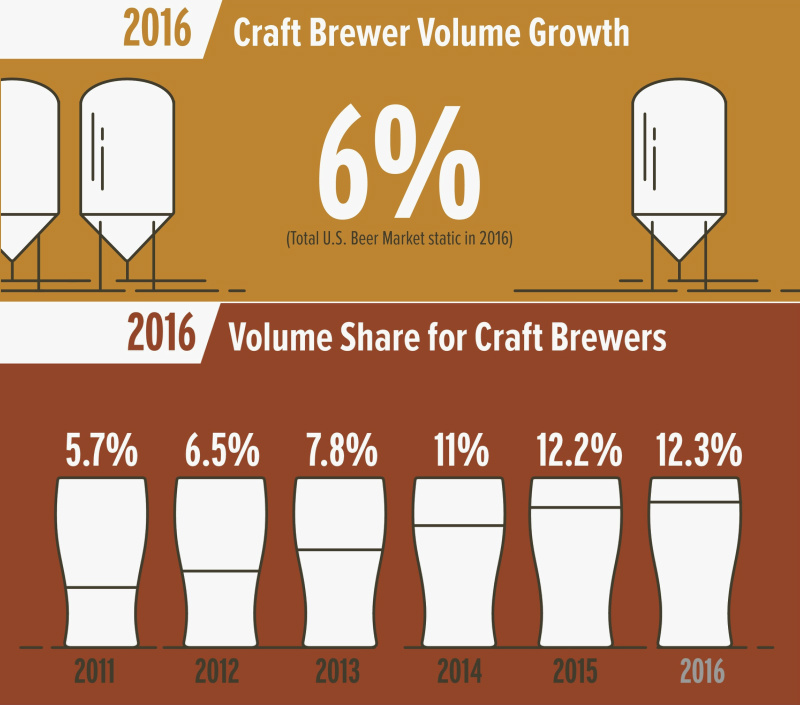
The Brewers Association has come out with its annual analysis of craft brewer growth, and it’s getting harder to tell whether the glass is half full or half empty.
That’s evident from the headlines regarding yesterday’s report. The beer blogosphere tended to repeat the association mantra of “steady growth,” while the mainstream media offered the likes of “Craft beer growth slows substantially in 2016” ( Paste ) and “Big beer acquisitions slows craft beer growth” ( USA Today ).
So who’s right? They all are, depending on how you want to spin the stats.
The bottom line: Production rose by 6 percent last year among what the Brewers Association considers “craft brewers,” those who are smaller and independently owned. That’s less than half the 13 percent growth rate recorded in 2015, and the first time since 2009 that the number has dropped below 10 percent.
Craft’s share of the total beer market inched up to 12.3 percent from 12.2 percent in 2015, by volume. (By dollars, it’s higher – 21.9 percent – because craft beer costs more.)
From there, things start getting a bit murky. According to the association, craft beer production totaled 24.6 million barrels last year, up from 24.3 million in 2015 – a difference of just over 1 percent.
So where does the 6 percent growth figure come from? A few large breweries who were part of the 2015 total, including Lagunitas and Ballast Point, have been bought by bigger companies since then and are no longer considered “craft” by the association.
And if you go back and subtract them from the 2015 numbers, you get 23.1 million barrels – or 6 percent less than last year’s 24.6 million.
That sort of mathematical gymnastics is becoming commonplace in the Brewers Association’s calculations. The wave of craft brewery acquisitions by Big Beer over the past few years has muddied the statistical waters and cost the association some significant contributors to its former totals, including Goose Island, Founders and Elysian.
(The association balanced things out somewhat in 2014 by changing its definitions to bring other breweries into the fold, such as Yuengling, which instantly became the biggest accredited craft brewer.)
And with the financial support of their well-heeled new owners – including access to wider distribution channels – those bought-out breweries are poised for faster growth than many of their former craft comrades. Elysian’s production was up 18 percent last year, Washington State Liquor and Cannabis Board reports indicate.
Bart Watson, the Brewers Association’s chief economist, drew the distinction in a blog post accompanying Tuesday’s report: “The goal of this release is not to measure the health of craft beer (which the BA doesn’t define). We are trying to measure the health of small and independent brewers .”
One thing is crystal clear: The burgeoning number of breweries nationwide isn’t slowing down. The Brewers Association counted 5,301 operating breweries last year, an increase of 17 percent – on top of 15 percent growth the previous year. There were 826 brewery openings and 97 closings.
And smaller players are making their mark. Microbreweries (producing less than 15,000 barrels per year) and brewpubs accounted for 90 percent of last year’s craft production growth, the association says, as opposed to regional craft breweries (up to 6 million barrels) – who are the ones getting squeezed between all those little local breweries at the bottom, and the fast-growing Goose Islands and Elysians at the top.
“Small and independent brewers are operating in a new brewing reality still filled with opportunity, but within a much more competitive landscape,” Watson wrote.
“The average brewer is getting smaller and growth is more diffuse within the craft category, with producers at the tail helping to drive growth for the overall segment.”
* This story was originally published as a post from the blog "On Tap." Read all stories from this blog